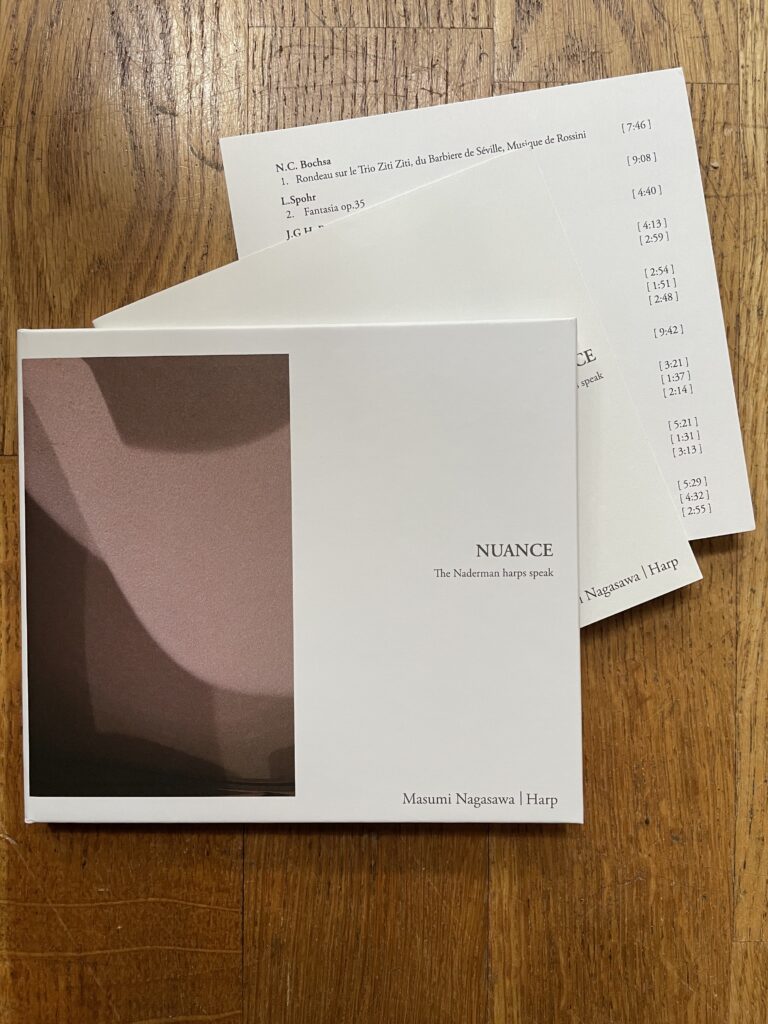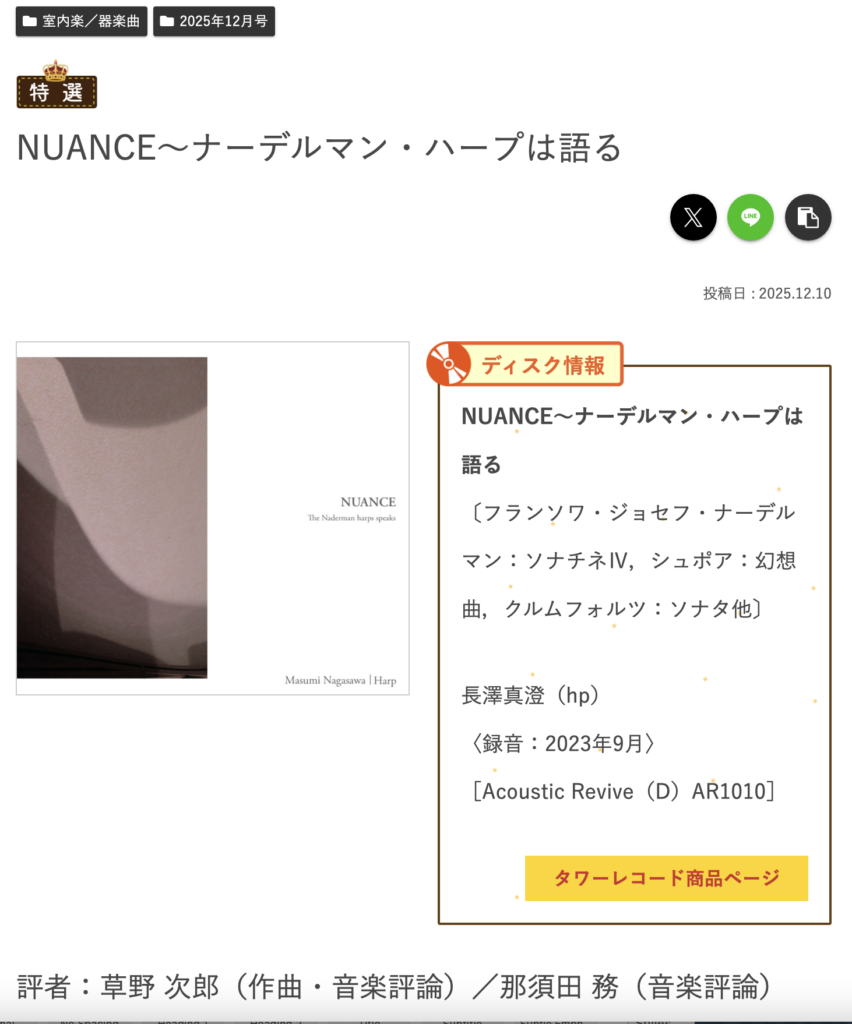
It was a delightful surprise and an honour that my CD ‘NUANCE ~ The Naderman harps speak’ received a ‘Special selection from the prestigious Japanese music magazine last December.
Here are the 2 reviews:
Harpist Masumi Nagasawa moved to the Netherlands at the age of seventeen, where she undertook rigorous training, won numerous awards, and has since established an active career throughout Europe. While she frequently appears as a soloist and with orchestras, she is also dedicated scholar of the harp. This recording features two rare period harps by the celebrated eighteenth and the nineteenth-century harp builders the Naderman father and son, and can be regarded as a particularly valuable release. These period instruments differ significantly from the modern harp in pedal technique, fingering, and other aspects of performance practice, and it appears that Nagasawa undertook a complete re-learning process in order to master them.
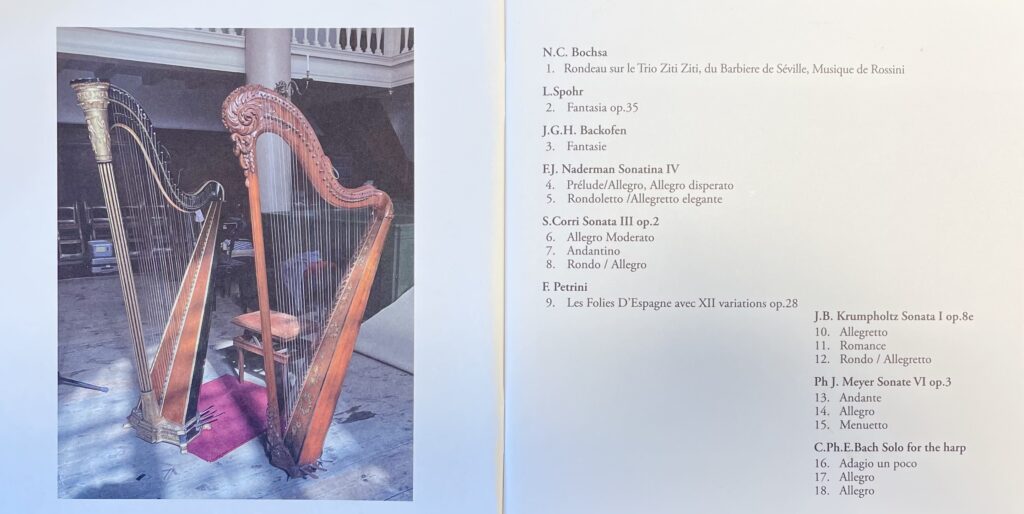
The CD opens with Bochsa’s ” Rondeau sur le Trio Ziti Ziti“, from The Barber of Seville by Rossini, and from the very first notes the sound reveals itself to be quite unlike that of the modern harp. Though more modest in volume, it is extraordinarily delicate, with a wealth of subtle timbral nuances unfolding from the softest pianissimo. Its beauty seems to transport the listener to an eighteenth century court, sustaining a jewel-like resonance that creates such a vivid illusion throughout.
The program then moves through the works by nine composers in total, ranging from Spohr’s Fantasie to C.P.E. Bach’s Harp Solo. Rather than merely reproducing period music on historical instruments, Nagasawa brings each piece vividly to life through her acute sensitivity to character, nuance, and expression, creating a series of intimate microcosmos.Particularly striking is Petrini’s Spanish Folia / Twelve Variations, whose diverse techniques and expressive transformations are rendered with remarkable brilliance. ( by J. KUSANO)
It is a beautiful album, featuring two period harps from the renowned French Naderman workshop, famed for having built instruments for Marie-Antoinette. Nagasawa performs on a 1771 harp by Jean-Henri Naderman, dating from Mozart’s era, and a second instrument, built by his son in 1815. Both are introduced in the booklet’s color photographs, along with Nagasawa’s own essay, ” The Naderman Harp Speaks”which explains the fundamental differences between these historical instruments and the modern harp.
With their longer strings and lower tension, eighteenth and nineteenth century harps require a fundamentally different approach to sound production–much as the fortepiano does–and Nagasawa meets this challenge with exceptional sensitivity. Performing music such as Bochsa, Naderman, Corri, Krumpholtz, Meyer and C.P.E. Bach, composers who were contemporaries of the instrument, she draws from them an elegant , unforced beauty of tone. Her refined phrasing, subtle expression, and varied articulation create a graceful sense of musical “narrative” conveying not only the sound but also the spirit of late Bourbon-era France. The album’s title, ” NUANCE – The Naderman harps speak” is thus entirely convincing. ( T. NASUDA)